Taiwan Eyes Chance to Join Global Race in System Integration
United Daily News Report, September 15, 2026
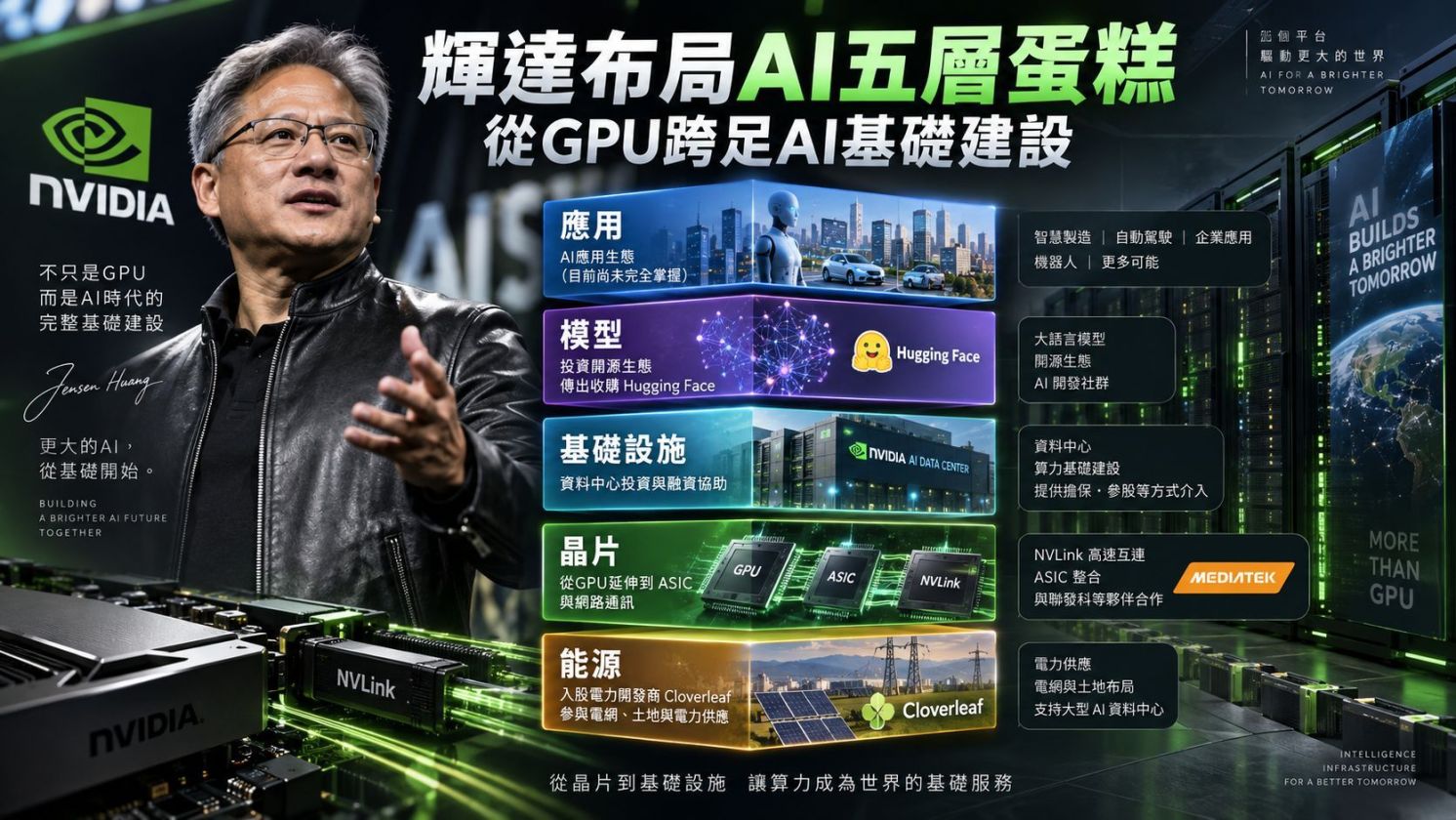
At the GPU Technology Conference (GTC) this year, Nvidia CEO Jensen Huang proposed the “five-layer cake” theory of artificial intelligence (AI), consisting, from the bottom up, of energy, chips, infrastructure, models, and applications. At the time, it appeared more like an industry framework. Looking back at Nvidia’s recent investments and partnerships, however, these five layers are gradually becoming the actual scope of its strategic expansion. What Huang wants to control is no longer limited to graphics processing units (GPUs).
Let us first look at the infrastructure layer. Although Nvidia has not directly invested capital to build data centers, it has become involved through such means as providing guarantees and taking equity stakes, helping to bring a number of data center projects to fruition. This approach naturally carries risks as well. If a customer runs into trouble, Nvidia would have to assume corresponding responsibilities.
In addition, MediaTek is a company worth paying close attention to in Nvidia’s strategic expansion. Nvidia’s investment in MediaTek should also be viewed in the context of the competitive landscape of data centers. When discussing Nvidia’s competitors, people typically think of AMD. But if the scope is expanded to the entire AI data center, Broadcom is likewise a competitor that cannot be overlooked.
Broadcom’s strength lies in networking and communications, particularly connections between servers and between chips, while Nvidia has its own NVLink, a high-speed chip interconnect technology. In the future, data centers cannot rely on GPU computing forever. Increasingly, customized ASICs will also emerge. If Nvidia cannot ensure that all computing workloads run on its own GPUs, it at least hopes that high-speed communication between these ASICs and GPUs will continue to use NVLink.
MediaTek’s value lies in its ability to help integrate NVLink into more ASIC designs, allowing Nvidia’s influence to extend from GPUs to the computing architecture of data centers.
If Nvidia’s strategy is viewed through the lens of the “five-layer cake,” its entry into the model layer can already be seen through its investments in the open-source ecosystem, and it has recently also been reported to be considering the acquisition of Hugging Face. At the infrastructure layer, there are investments in data centers and financing assistance. At the chip layer, Nvidia is extending beyond GPUs into ASICs and networking and communications. Energy is an issue that all large-scale AI data centers cannot avoid. Nvidia has taken a stake in data center power developer Cloverleaf, directly participating in the development of the power grid, land, and electricity supply. As for the top application layer, Nvidia has not yet gained complete control. Nevertheless, among the five layers, signs of Nvidia’s strategic expansion can already be seen in every layer except applications.
This line of thinking is actually very similar to the “Wintel” (Windows + Intel) model of the PC era. At the time, Intel controlled the processors while Microsoft controlled the operating system, and the two companies jointly established the standards of the PC industry. What Huang is trying to do now is to enable Nvidia to control hardware, software, computing power, and infrastructure simultaneously in the AI era.
However, this strategy has also raised concerns about circular investment. Such concerns are not entirely unfounded, but neither are they entirely justified. What Huang truly needs to guard against is excessive customer concentration. If major customers reduce or postpone their capital expenditures, the entire supply chain could be shaken as a result. But this is more akin to the risk of supply-chain disruption caused by tightening cash flow, rather than a lack of market demand.
Looking back over the past three years, the market has spent too much effort debating which model is more powerful. Taking a longer-term view, rankings among models may no longer be the key issue. What will truly determine the winners and losers is who can steadily build out AI infrastructure. The models are merely the key fuse that triggers the entire business model. What Nvidia is doing now is turning computing power into a basic service. It is not simply selling chips. And MediaTek’s being brought into the core of this strategy represents a rare opportunity for a Taiwanese company to participate in this global competition at the level of system integration.
(The author is former managing director of Google Taiwan.)